Jewelry photography guide
Photographing Reflective Jewelry: How to Control Reflections
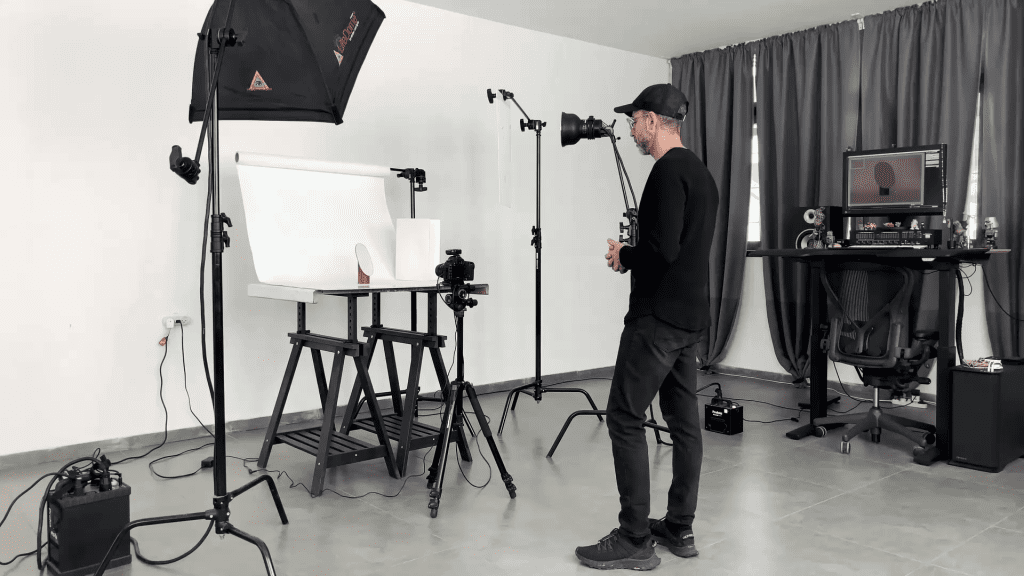
Polished metal does not have an appearance of its own. A gold band, a silver cuff or a chrome clasp shows exactly one thing: whatever is in front of it, at the angle the camera happens to be looking. Every unwanted highlight, dark smear or ghost of the camera in a jewelry image is a reflection of something in the room. Learning to control reflections is therefore the core skill of jewelry photography, and it is why the practical chapter of the course starts with a mirror and a chrome sphere before it touches a single piece of jewelry.
The family of angles
A reflection follows one rule: the angle at which light arrives equals the angle at which it leaves. For a flat polished surface that means the camera sees a reflection of whatever sits at the mirror-image of its own position. For a curved surface, a ring band or a sphere, the same rule applies at every point, so the surface shows a compressed, distorted map of everything around it. Photographers call the range of directions a surface can reflect into the lens its family of angles. Control the objects inside that family and you control what the metal looks like; objects outside it cannot appear, no matter how bright they are.
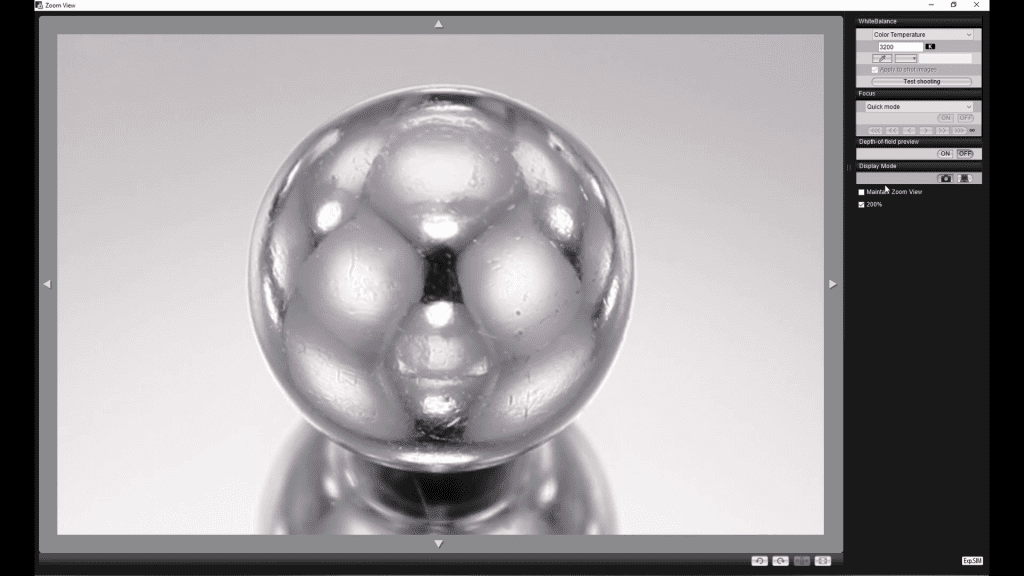
This is why a jewelry photographer rarely points a light at the metal. The light is pointed at a panel or card that sits inside the family of angles, and it is the panel that the metal shows. It is also why a chrome sphere is the perfect teaching object: its family of angles covers almost the whole room, so every light, card and gap is visible on its surface at once.
Start with a mirror, then a sphere
The course’s practical chapter includes two exercises, done before any jewelry, that are worth copying. First a flat mirror is photographed: the aim is a frame in which the mirror shows a clean, even tone with no camera, no photographer and no room. Achieving it forces the first real decisions: where the camera must stand, what has to be placed in the mirror’s family of angles, and how a panel is lit so its reflection is even. The free tutorial Photographing Mirrors on Ivan Moshe’s channel demonstrates the exercise.
Then the chrome sphere, over two lessons. Because a sphere reflects in every direction, it cannot be solved by camera position alone; it has to be enclosed. Panels and cards are built around it until the surface shows only what the photographer placed there: a bright gradient from the main panel, dark bands from the black cards, and nothing else. Every real piece of jewelry is a fragment of that sphere, so a photographer who can light the sphere can light the piece.
The tools: panels, cards and flags
- Diffusion panel: a large translucent surface lit from behind or from the side. It becomes the main bright reflection in the metal, and lighting it unevenly produces the gradient that makes metal look round.
- White card: a soft, bright reflection. Used to fill a dark area of the metal or to brighten an edge.
- Black card: a dark reflection. Used to give polished surfaces an edge, add contrast to a band, and stop the metal from reading as a flat white sheet.
- Flag: a black card used to block light from reaching a surface or a background, rather than to be reflected.
- Gaps: the spaces between panels and cards reflect the room. On a chrome surface they appear as dark or colored stripes; closing them is as important as placing the cards.
Enclosing the set
For highly polished pieces, the set becomes a small room of its own: panels above and on both sides, cards filling the gaps, and the lens looking in through an opening just large enough for the front of the lens. Even that opening appears on the metal as a dark spot, which is handled in one of three ways: by moving the camera so the spot lands on a part of the piece that is dark anyway, by covering the front of the lens and the camera with a white or gray card with a hole for the lens, or by removing the spot in retouching.
The enclosure also fixes color. A room has colored walls, a wooden floor and a window, and polished metal picks up all of them as casts. Inside neutral white and black panels, the metal shows neutral tones, which is the only starting point from which a calibrated monitor and a retoucher can judge true color.
Reflections you want to keep
Not every reflection is a problem. The reflection of the piece in a glossy surface beneath it is part of most catalog images and is lit as carefully as the piece. The gradient on a band is a reflection. The dark edge on a cuff is a reflection. The skill is not removing reflections but choosing them: every tone on the metal should be something you placed inside the family of angles on purpose.
Common problems
- A dark blob in the middle of the band: the camera. Move it, shield it, or retouch it.
- Colored streaks on silver: a wall or window inside the family of angles. Close the gap with a card.
- The metal is a flat white sheet: the panel is too even and too close with no black cards. Add dark edges.
- The piece looks gray and dull: too many black cards, or the panel is not lit brightly enough. Open the set up.
- The same reflection moves when the piece is turned: it is supposed to. Reset the cards for every new view.
Learn reflections the way the course teaches them
Mastering Jewelry Photography teaches reflection control in order: the four-lesson Lighting chapter on the properties of light, reflection and diffusion, then the practical chapter that begins with Photographing the Mirror and two lessons on Lighting the Metal Sphere before moving to rings, bracelets, earrings and necklaces. 49 lessons across 12 chapters, one-time payment of $99, lifetime access.
Related guides
- How to Photograph Jewelry: Professional Lighting Techniques: the principles behind every setup
- Jewelry Photography Studio Setup: lighting, grip and workspace
- How to Photograph Rings: lighting, focus and composition
- Camera Settings for Jewelry Photography: sharpness and exposure
About the author
Ivan Moshe is a commercial photographer and high-end retoucher who has photographed products for the advertising industry for more than 15 years, from his studio in Tel Aviv’s Diamond District. He was selected for Lürzer’s Archive 200 Best Ad Photographers Worldwide in 2021/22 and 2023/24, and he teaches Mastering Jewelry Photography, the online course these guides are drawn from.